
If you’re setting up a factory, plant, or any industrial unit in Maharashtra, you’ve almost certainly come across the term MPCB. You may have been told you need MPCB consent before you can begin construction or start operations — but what exactly is MPCB, what does it do, and how does the whole process actually work?
This guide answers all of that in plain language. Whether you’re a first-time entrepreneur navigating compliance for the first time or a production manager trying to understand why your renewal is stuck, this is the resource you need.
We’ve been helping industries across Maharashtra — including Navi Mumbai, Pune, Thane, and MIDC zones — navigate MPCB compliance for over 10 years. What you’ll read here comes from that real-world experience, not textbook theory.
What Is MPCB? — Quick Answer
MPCB stands for Maharashtra Pollution Control Board. It is a statutory authority established under the Water (Prevention and Control of Pollution) Act, 1974, and is responsible for enforcing environmental regulations across the state of Maharashtra. Any industry or establishment that generates air, water, or land pollution must obtain MPCB consent before commencing operations.
Short answer (40–60 words): MPCB — or Maharashtra Pollution Control Board — is a government regulatory body in Maharashtra that controls industrial pollution. It issues environmental consents and certificates that industries must obtain before starting construction or operations. Without valid MPCB consent, running an industrial unit in Maharashtra is illegal.
MPCB Full Form and What It Stands For
The MPCB full form is Maharashtra Pollution Control Board.
It is the State Pollution Control Board for Maharashtra, operating under the Ministry of Environment, Forest and Climate Change (MoEFCC) at the central level, while being administered by the Government of Maharashtra at the state level.
Other state pollution control boards exist across India — like GPCB (Gujarat), CPCB (Central), TNPCB (Tamil Nadu) — but MPCB has jurisdiction specifically over the state of Maharashtra, one of India’s most industrially active states.
What Does MPCB Do? — Its Role and Functions
The Maharashtra Pollution Control Board does far more than just issue certificates. Here’s what it actually oversees:
- Pollution Monitoring MPCB monitors air quality, water quality (rivers, lakes, and groundwater), and soil contamination across Maharashtra — especially around industrial zones.
- Issuing Environmental Consents Every industry that produces pollution must get consent from MPCB. There are two main consents — Consent to Establish (CTE) and Consent to Operate (CTO). More on these below.
- Enforcing Compliance MPCB conducts surprise inspections, issues show-cause notices, and can seal or shut down facilities operating without valid consents or violating pollution norms.
- Hazardous Waste Regulation Industries generating hazardous waste must follow MPCB guidelines for storage, transport, and disposal — and file annual returns.
- Environmental Impact Assessment (EIA) Support For large projects, MPCB provides clearances and participates in the EIA process required before construction begins.
- E-Waste Compliance Electronics manufacturers and recyclers must comply with E-waste rules administered through MPCB.
MPCB Consent — What Is It and Why Do You Need It?
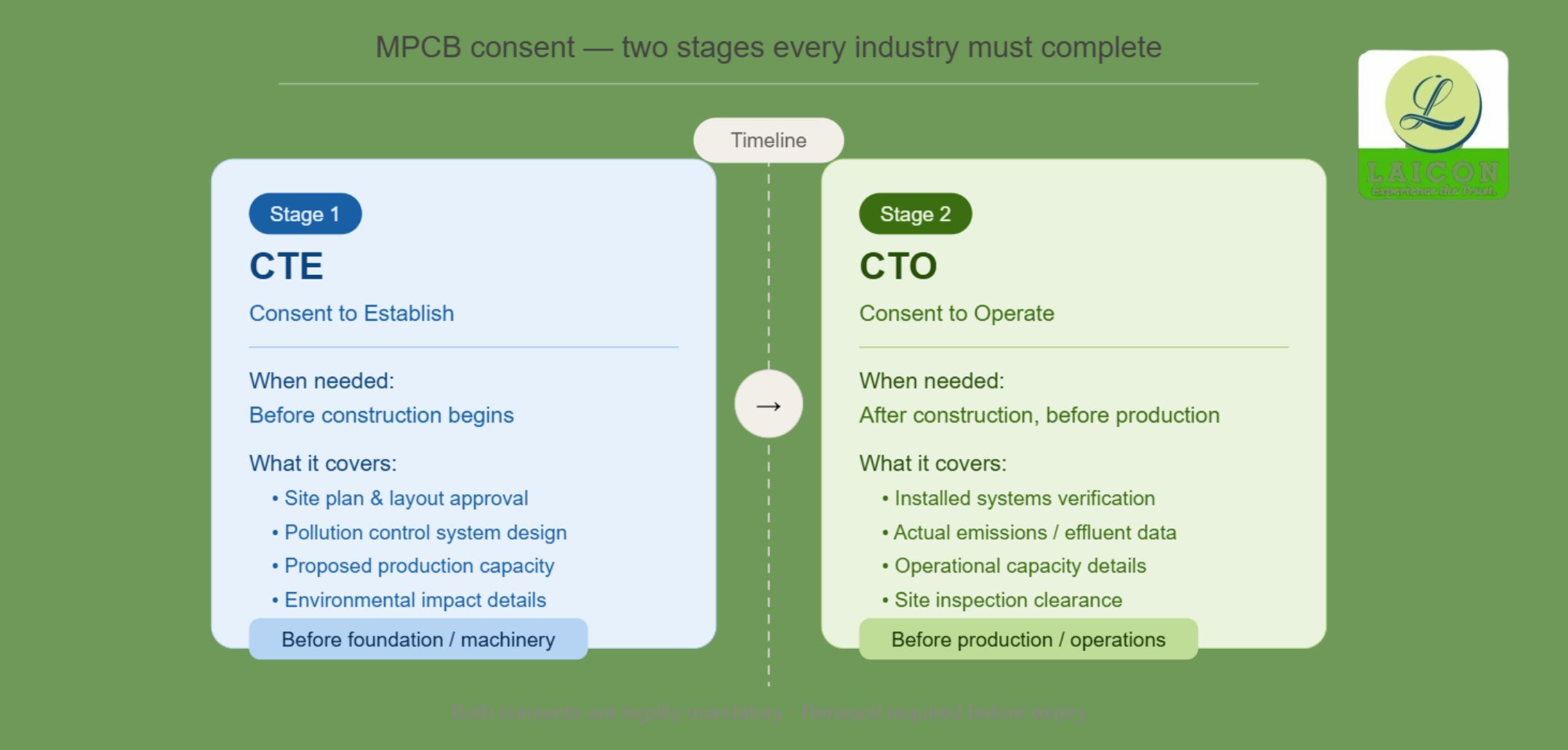
MPCB consent is the official permission granted by the Maharashtra Pollution Control Board that allows an industry to establish itself or operate at a given location. It is not optional — it is a legal requirement under Indian environmental law.
There are two types of MPCB consent that every applicable industry must obtain:
Consent to Establish (CTE)
What it is: Permission granted before you begin construction of your industrial facility.
When you need it: Before laying a foundation, installing machinery, or building anything that will form part of your industrial plant.
What it involves: Site plan submission, pollution control system design, environmental impact details, and proposed production capacity.
Think of CTE as the environmental “building permission” — you can’t dig until you have it.
Consent to Operate (CTO)
What it is: Permission to actually start operations once your facility is built.
When you need it: After construction is complete and before you begin production, processing, or any activity that generates pollution.
What it involves: Verification that your installed pollution control systems match what was approved in the CTE, actual emissions/effluent data, and operational details.
CTO is the green flag that says your facility is environmentally ready to run.
MPCB Consent Renewal
Both CTE and CTO are time-limited. Depending on your industry category (Red, Orange, Green, or White), they need to be renewed periodically. Failing to renew on time is treated as operating without consent — which carries penalties and risk of closure.
MPCB Industry Categories — Red, Orange, Green, White
MPCB classifies industries based on their pollution potential. This determines how strictly they’re monitored and what fees and documentation they require.
Category | Pollution Level | Examples |
Red | Highly Polluting | Chemical plants, cement, steel, pharma |
Orange | Moderately Polluting | Food processing, textiles, auto components |
Green | Low Polluting | Bakeries, paper products, light engineering |
White | Negligible Pollution | Software companies, education institutes |
Red category industries face the highest compliance burden and most frequent inspections. White category industries may be exempt from consent requirements in many cases.
Knowing your category before applying is critical — the wrong classification wastes time and money.
MPCB Registration Process — Step by Step
Here’s how the MPCB registration process works in practice, based on our decade of experience handling these applications:
Step 1 — Determine Your Industry Category Identify whether your operation falls under Red, Orange, Green, or White category using the MPCB/CPCB classification list.
Step 2 — Prepare Your Documentation Gather required documents:
- Site plan and layout drawing
- Project report describing production processes
- Details of pollution control systems (effluent treatment plant, air emission controls)
- Land ownership or lease documents
- Consent from local authority (MIDC allotment letter or municipal NOC)
- Environmental details — water consumption, effluent generation, air emissions, waste generation
Step 3 — Submit Application on MPCB’s Online Portal Applications are now filed through MPCB’s aaple sarkar or dedicated online portal. Forms must be accurately filled and supporting documents uploaded.
Step 4 — Pay Applicable Consent Fee Fees are calculated based on your industry category, capital investment, and production capacity.
Step 5 — Site Inspection by MPCB Officer MPCB officials typically conduct a site inspection to verify that your facility and pollution control arrangements match your application.
Step 6 — Grant of Consent If everything is in order, MPCB issues the CTE or CTO. For complex Red category industries, this may involve review by a committee.
Step 7 — Ongoing Compliance After consent, you must maintain compliance — submit logbooks, annual environment reports (Form 5), hazardous waste returns, and online manifests as applicable.
⚠️ Common mistake: Many first-time applicants underestimate the documentation depth required, especially for Red and Orange category industries. An incomplete application is returned without processing — costing weeks of delay.
What Is an MPCB Certificate?
An MPCB certificate is the formal document issued by the Maharashtra Pollution Control Board confirming that your industry has been granted Consent to Establish (CTE) or Consent to Operate (CTO).
This certificate:
- Bears the MPCB seal and authorized signature
- States the consent period (validity dates)
- Lists conditions the industry must comply with (emission limits, waste handling norms, etc.)
- Specifies the consent category and production capacity permitted
Your MPCB certificate must be displayed at your facility and produced during any regulatory inspection.
What Is an MPCB License?
The term MPCB license is commonly used interchangeably with MPCB consent, though strictly speaking, the formal term in legislation is “consent.” In everyday usage — especially in manufacturing and MIDC circles — when someone says “MPCB license,” they mean either the CTE or CTO (or both).
Some specific authorizations, such as hazardous waste storage authorization, are referred to as “authorizations” rather than licenses — but these too fall under MPCB’s jurisdiction.
Why Operating Without MPCB Consent Is Risky
This is something we see more often than you’d expect — businesses that have been operating for months or years without completing their MPCB compliance, often unaware of the exposure this creates.
Here’s what can happen:
- Closure orders — MPCB can seal your facility immediately upon inspection
- Fines and penalties under the Environment Protection Act and Water/Air Acts
- Criminal liability — directors and owners can face prosecution
- Bank/finance complications — lenders increasingly require MPCB compliance as part of due diligence
- MIDC lease complications — MIDC can initiate action on allotted plots where MPCB compliance is missing
The cost of proper compliance is almost always a fraction of the cost of enforcement action.
Ongoing MPCB Compliance — What Industries Must Do After Getting Consent
Getting consent is the beginning, not the end of your MPCB obligations. Here’s what ongoing compliance looks like:
Annual Returns
- Form 4: Hazardous waste annual return (for applicable industries)
- Form 5: Environmental status report (annual)
Online Logbooks Applicable industries must maintain and submit digital logbooks of pollution control equipment performance.
Manifest System Hazardous waste transported off-site must be accompanied by an MPCB manifest, submitted online.
Consent Renewal Must be filed before expiry — late renewals attract additional fees and scrutiny.
E-Waste Returns (Form 3) Electronics-related industries must file Form 3 returns for e-waste compliance.
Extended Producer Responsibility (EPR) Applicable for producers of plastics, e-waste, and batteries who must register and comply with EPR norms.
Managing all of this simultaneously while running a business is where most industries struggle — and where a professional MPCB consultant adds the most value.
How We Help — Our MPCB Consultancy Services
We’ve been handling MPCB applications, renewals, and compliance management for industries across Maharashtra for over 10 years, working from our office in Navi Mumbai’s Sanpada area. Our clients range from small manufacturing units to large chemical and pharmaceutical facilities.
Our MPCB consultant services include:
- Consent to Establish (CTE) — full application preparation and submission
- Consent to Operate (CTO) — documentation, inspection coordination, and follow-up
- Consent Renewal — timely filing before expiry to avoid lapse
- Hazardous Waste Authorization — authorization applications and annual returns (Form 4)
- Environmental Status Reports (Form 5) — preparation and submission
- Online Logbook & Manifest Management — system setup and submission support
- E-Waste Compliance (Form 3) — return preparation for electronics industries
- Extended Producer Responsibility (EPR) — registration and compliance management
Every case is handled by our team directly — no outsourcing, no middlemen. We stay with clients through inspections, show-cause notices, and renewals, not just initial applications.
Common Mistakes Businesses Make with MPCB Compliance
Based on what we see regularly:
❌ Starting construction before obtaining CTE — one of the most common and costly mistakes. MPCB can order demolition of unauthorized construction.
❌ Filing the wrong industry category — leads to application rejection or post-approval complications during inspections.
❌ Incomplete pollution control system details — applications without proper ETP or air control system specifications are routinely returned.
❌ Missing renewal deadlines — operating on an expired consent is treated the same as having no consent at all.
❌ Ignoring ongoing compliance obligations — getting CTO and then forgetting about Form 4, Form 5, and logbooks invites penalty during inspections.
❌ Not keeping consent documents accessible — inspecting officers expect original documents on-site.
MPCB vs CPCB — What’s the Difference?
Feature | MPCB | CPCB |
Full Form | Maharashtra Pollution Control Board | Central Pollution Control Board |
Jurisdiction | Maharashtra state only | All of India |
Authority | State Government | Central Government |
Role | Issues consents; enforces state pollution norms | Sets national standards; coordinates state boards |
Application for consent | Through MPCB | N/A (CPCB doesn’t issue consents directly) |
For industries in Maharashtra, MPCB is the relevant authority for all environmental consents and compliance. CPCB sets the overarching standards that MPCB enforces.
Conclusion
MPCB — Maharashtra Pollution Control Board — is the environmental regulatory backbone for industries operating in Maharashtra. Whether you’re at the planning stage and need a CTE, ready to launch and need a CTO, or running an established plant that needs renewal and ongoing compliance management, the MPCB process is non-negotiable.
The good news: with the right expertise and support, MPCB registration and compliance is entirely manageable. The challenge is understanding what’s required, preparing documentation correctly, and following through consistently — which is exactly what we do for our clients.
If you’re starting fresh, struggling with a pending application, or overdue on a renewal, reach out. We’ll assess your situation, tell you exactly where you stand, and take the process off your plate.
FAQ
What is MPCB?
MPCB stands for Maharashtra Pollution Control Board. It is a statutory government body in Maharashtra responsible for preventing and controlling air, water, and land pollution. It issues consents (permissions) that industries must obtain before establishing or operating a facility that generates any form of pollution.
What is the full form of MPCB?
The MPCB full form is Maharashtra Pollution Control Board. It is the State Pollution Control Board for Maharashtra, functioning under the Water (Prevention and Control of Pollution) Act, 1974, and the Air (Prevention and Control of Pollution) Act, 1981.
What does MPCB do?
MPCB monitors pollution levels, issues environmental consents to industries, conducts facility inspections, regulates hazardous waste, and enforces environmental laws in Maharashtra. It can issue fines, seal facilities, or initiate prosecution against industries that violate pollution norms.
What is MPCB consent?
MPCB consent is the official permission granted by the Maharashtra Pollution Control Board for an industry to establish itself (Consent to Establish / CTE) or begin operations (Consent to Operate / CTO). Both are legally mandatory for most industrial units in Maharashtra.
What is the difference between CTE and CTO?
CTE (Consent to Establish) is obtained before construction begins and permits an industry to build its facility. CTO (Consent to Operate) is obtained after construction and permits the industry to begin production. Both are MPCB consents but apply to different stages of a project.
What is an MPCB certificate?
An MPCB certificate is the formal document issued by MPCB confirming that your industry has been granted Consent to Establish or Consent to Operate. It includes validity dates, compliance conditions, and permitted production capacity. It must be displayed at your facility.
How long does MPCB consent take?
MPCB consent processing typically takes 30 to 90 days, depending on the industry category (Red, Orange, Green), complexity of the application, and completeness of documentation. Red category industries may take longer due to detailed scrutiny. Professionally prepared applications with complete documents process faster.
What is the MPCB registration process?
The MPCB registration process involves: (1) determining your industry category, (2) preparing documents including site plan, project report, and pollution control details, (3) filing online on MPCB’s portal, (4) paying consent fees, (5) undergoing site inspection, and (6) receiving your consent order.
What happens if I operate without MPCB consent?
Operating without MPCB consent can result in closure orders, heavy fines, criminal liability for directors, and complications with bank loans and MIDC lease agreements. MPCB regularly conducts surprise inspections and has the authority to seal facilities immediately.